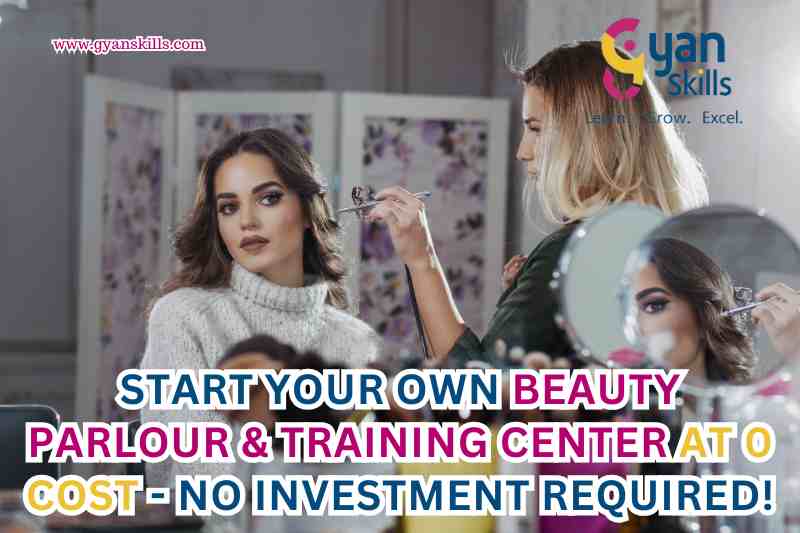
START YOUR OWN BEAUTY PARLOUR & TRAINING CENTER AT 0 COST – NO INVESTMENT REQUIRED!
Start Your Own Beauty Parlour & Training Centre Franchise
Are you planning to start a beauty parlour, beauty academy or beauty training centre? If you already have experience in beauty and wellness—or simply want to build a skill-development business—an education franchise can give you a structured way to enter the training sector.
Gyan Skills Academy currently promotes a franchise and partner model covering beauty care, vocational training, IT, fitness, AutoCAD and other skill-development programmes. Its published information also highlights a portfolio of 300+ courses, online verification and partner support.
This guide explains what you should know before starting a Beauty Parlour & Training Centre, what students expect from a beauty course, which courses you can explore, what facilities may be required, how certification works and how to apply for the franchise.
Want to Start a Beauty Training Centre?
Talk to Gyan Skills Academy about the current franchise model, course availability, partner requirements and registration process.
What Is a Beauty Parlour & Training Centre Franchise?
A Beauty Parlour & Training Centre Franchise combines two closely related activities: beauty services and beauty education.
A traditional beauty parlour primarily focuses on serving customers with services such as makeup, hair styling, skincare and grooming. A beauty training centre adds another layer—it teaches students how to develop those skills professionally.
With a franchise model, an eligible partner can operate a local training centre using the course portfolio, systems, support and branding available through the education organisation.
The advantage is that you do not necessarily have to develop every part of the training operation from scratch. You can focus on your local market, student counselling, practical training, centre management and student experience while using the available education platform.
Important: “₹0 franchise fee” does not mean that every possible business expense is zero. The current Gyan Skills Academy information says there is no franchise registration charge, while also noting that offline centres require physical facilities. Rent, furniture, equipment, electricity, internet, staff and local marketing can still be relevant operating costs.
Why Start a Beauty Training Centre?
Beauty and wellness is a practical, skill-based field. Students often want to learn something they can practise immediately rather than spending months only studying theory.
A good beauty training institute can help learners develop practical skills in areas such as makeup, hair styling, skincare, nail care and salon services.
For entrepreneurs, a training centre can also complement an existing beauty parlour or salon. Instead of serving only customers, you can explore a second audience: people who want to learn the skills themselves.
What Beauty Courses Can a Training Centre Offer?
The exact course portfolio should always be confirmed with the franchise provider before you advertise a particular programme. The source material for this centre specifically identifies several beauty and wellness areas.
| Course / Skill Area | What Students May Learn |
|---|---|
| Hair Styling | Haircare basics, styling techniques, salon practices and practical hair-styling skills. |
| Skin Treatments | Basic skincare knowledge, skin-care routines and appropriate salon treatment techniques. |
| Bridal Makeup | Bridal makeup preparation, base application, eye makeup, finishing and client-focused makeup practice. |
| Nail Art & Extensions | Nail preparation, decorative techniques and applicable nail-extension skills. |
| Beauty & Wellness | Additional beauty and wellness programmes available through the current course portfolio. |
Why Practical Training Matters in Beauty Courses
If you ask students what they really want from a beauty course, the answer is usually not just a certificate. They want to know whether they will actually be able to do the work after completing the course.
That means a strong beautician course should combine explanation with demonstrations, supervised practice and opportunities to work on different faces, hair types, skin needs or nail designs where appropriate.
Recent discussions from people considering professional makeup training reflect the same concern. Learners commonly ask whether a short course provides enough practical experience, whether certification actually helps, and whether they should focus more on their portfolio and real-world skills.
For students: Before enrolling, ask how much practical work is included. A certificate can document course completion, but your ability to perform a service confidently and professionally is what you will ultimately need when working with clients.
Beauty Course vs Watching YouTube Tutorials
Online videos can be useful for learning techniques, discovering products and getting inspiration. But they cannot always replace supervised practical training.
A structured beauty course can give students:
- A planned learning sequence
- Trainer demonstrations
- Opportunities to ask questions
- Practical assignments
- Feedback on technique
- Exposure to professional routines
- Guidance on client handling
- A structured assessment and certification process
Interestingly, this is a question students themselves continue to ask online: Can I learn makeup from YouTube, or should I join a class?
The practical answer is that the best choice depends on your goal. If you only want to improve your own makeup, online tutorials may be enough for some learners. If you want to work professionally, structured training and repeated hands-on practice can be much more useful.
Who Can Start a Beauty Parlour & Training Centre?
A beauty training centre can be relevant to several types of entrepreneurs and professionals.
- Beauticians: Professionals who want to teach the skills they already use.
- Salon Owners: Existing salon or parlour owners who want to add training to their business.
- Makeup Artists: Professionals who want to teach makeup techniques to beginners.
- Beauty Trainers: Trainers who want to operate under an established education platform.
- Teachers: Educators interested in practical vocational and skill development.
- Education Entrepreneurs: People who want to enter the training and education sector.
- Existing Training Centres: Institutes looking to add beauty and wellness programmes.
Do I Need to Be a Professional Beautician to Open a Beauty Training Centre?
Not necessarily. Running a training centre and personally teaching every course are different responsibilities.
If you want to teach students yourself, you should have appropriate knowledge and practical ability in the subject you are teaching. If you plan to manage the centre, you can discuss trainer requirements and course-delivery arrangements with the franchise provider.
A sensible approach is to make sure every course is taught by someone who genuinely understands the skill rather than treating the franchise as a substitute for professional expertise.
How to Start a Beauty Parlour & Training Centre
| Step | What You Should Do |
|---|---|
| 1. Research Your Local Market | Find out whether students in your area are looking for makeup, beauty, hair, skincare or nail-art training. |
| 2. Decide Your Business Model | Decide whether you want a training-only centre, a beauty parlour plus training model or an existing institute expansion. |
| 3. Contact the Academy | Ask about the current franchise programme, eligibility, courses and partner requirements. |
| 4. Understand the Commercial Terms | Confirm franchise charges, student registration charges, revenue sharing, renewal terms and any other applicable conditions. |
| 5. Arrange the Centre | Prepare the appropriate classroom, practical area, seating, lighting, equipment and other facilities required for your selected courses. |
| 6. Arrange Trainers | Make sure trainers have the practical knowledge and communication skills required to teach students. |
| 7. Register as a Partner | Complete the applicable partner-registration process through the official Gyan Skills Academy website. |
| 8. Promote Your Courses | Use local SEO, social media, WhatsApp, referrals, demonstrations and community outreach to attract students. |
| 9. Focus on Student Outcomes | Give students practical experience, feedback and guidance instead of focusing only on certificate distribution. |
Ready to Explore the Franchise?
Have a salon, beauty parlour, training institute or suitable location? Speak with the team before making your decision.
How Much Does It Cost to Start a Beauty Training Centre?
This is one of the biggest questions for anyone researching a beauty parlour franchise.
Gyan Skills Academy currently promotes a zero-franchise-fee model, meaning the academy states that there is no traditional franchise registration charge.
However, you should separate the franchise fee from the cost of running a beauty training centre.
Depending on your business model, you may still need to budget for:
- Rent or premises-related expenses
- Classroom furniture
- Mirrors and lighting
- Beauty and makeup equipment
- Hair styling tools
- Skincare equipment and supplies
- Nail-art materials
- Cosmetics and consumables
- Electricity and water
- Internet and communication
- Trainer or staff costs
- Local advertising
- Signage and branding
If you already own a beauty parlour or salon, you may already have some of the infrastructure needed for practical training.
Can I Start a Beauty Training Centre Without a Large Investment?
The franchise model can reduce the traditional franchise joining barrier because Gyan Skills Academy currently promotes no franchise registration fee.
But the amount required to actually operate the centre depends on your starting position.
Someone with an existing salon and equipment may need a very different budget from someone renting a new property and purchasing everything from scratch.
Before spending money, prepare a simple budget covering premises, equipment, trainers, marketing and at least the first few months of operating expenses.
What Equipment Is Needed for a Beauty Training Centre?
Equipment depends on which courses you plan to offer.
For Makeup Training
- Makeup brushes
- Mirrors
- Suitable lighting
- Makeup products
- Makeup stations
- Sanitisation supplies
- Practice models where appropriate
For Hair Styling
- Hair dryers
- Straighteners
- Curling tools
- Combs and brushes
- Practice mannequins where appropriate
- Salon chairs and mirrors
- Hair-care products
For Nail Art
- Nail-art tools
- Brushes
- Suitable nail products
- UV/LED equipment where applicable
- Practice tips or models
- Sanitisation supplies
For Skincare Training
- Facial beds or suitable treatment stations
- Basic skincare products
- Facial tools appropriate to the curriculum
- Clean towels and disposable supplies
- Proper hygiene and sanitisation facilities
How Long Does a Beauty or Beautician Course Take?
There is no single duration that is suitable for every beauty course.
The source material for this programme states that courses generally range from 1 to 3 months, depending on their complexity and depth.
However, the right duration should be determined by the actual syllabus and practical hours—not just by a marketing promise such as “learn everything in seven days.”
Students should ask how many total training hours they receive and how much of that time is practical.
What Is Included in a Good Beautician Course?
A well-structured beginner-to-professional beauty course may cover a combination of:
- Basic beauty and salon concepts
- Personal hygiene and workplace hygiene
- Client consultation
- Skin preparation
- Basic makeup techniques
- Hair styling fundamentals
- Basic skincare services
- Nail-care fundamentals
- Product selection
- Tool handling
- Practical demonstrations
- Supervised practice
- Client communication
- Professional presentation
- Basic business and service practices
The actual syllabus should be confirmed with the training provider before enrolment.
Is a Makeup Artist Course Worth It?
It can be—but the value depends heavily on the quality of the training and what you want to do afterwards.
A person learning makeup for personal use has different needs from someone who wants to become a freelance makeup artist or bridal makeup artist.
If your goal is professional work, look beyond the certificate. Consider:
- How much practical work is included?
- Can you practise on different models?
- Does the trainer provide feedback?
- Will you learn client consultation?
- Will you learn product selection?
- Does the course cover different makeup styles?
- Will you have enough work to start a portfolio?
These concerns are not theoretical. People researching professional makeup courses regularly ask online whether certificates matter as much as practical skill, reviews and portfolio quality.
Do You Need a Certificate to Become a Makeup Artist?
A certificate can be useful as evidence that you completed a training programme, but it should not be presented as the only thing that makes someone a professional makeup artist.
Clients may also look at your:
- Portfolio
- Before-and-after work
- Reviews
- Social media presence
- Professional behaviour
- Makeup quality
- Hygiene practices
- Communication
A recent Reddit discussion from someone planning a makeup career specifically raised the question of whether clients care more about certification or portfolio and social proof. The practical lesson is useful for students: build skills and evidence of your work alongside your certificate.
Can I Become a Freelance Makeup Artist After a Course?
A beauty or makeup course can provide a foundation for freelance work, but the course itself does not guarantee clients.
After training, a beginner may need to:
- Practise regularly
- Build a portfolio
- Work with models where appropriate
- Learn client communication
- Create social media profiles
- Collect genuine reviews
- Network with photographers, salons and event professionals
- Understand pricing and expenses
- Learn professional hygiene
One Reddit discussion from a beginner MUA also highlighted portfolio-building, regular practice, networking and social media as important parts of starting out.
Beauty Parlour Business vs Beauty Training Centre
| Beauty Parlour / Salon | Beauty Training Centre |
|---|---|
| Focuses mainly on providing beauty services to clients. | Focuses mainly on teaching beauty and wellness skills to students. |
| Revenue generally comes from customer services and product sales. | Revenue generally comes from applicable student enrolments and course fees. |
| Requires beauticians and service professionals. | Requires trainers and appropriate practical learning facilities. |
| Client experience is the main priority. | Student learning outcomes are the main priority. |
| Can serve as a practical environment for beauty professionals. | Can provide structured training for people entering the industry. |
Can an Existing Beauty Parlour Become a Training Centre?
Yes, an existing salon or beauty parlour can explore whether its premises and infrastructure are suitable for adding training.
This can be attractive because the business may already have:
- Beauty equipment
- Mirrors and chairs
- Lighting
- Existing customers
- Experienced beauticians
- Local brand awareness
Before starting classes, however, check whether the premises provide enough space and whether the current staff can support practical training without compromising customer service.
Can an Existing Training Institute Add Beauty Courses?
Yes. An existing education centre can explore adding beauty and wellness programmes to its current course portfolio.
This can be useful for centres that already have students interested in vocational or career-oriented courses.
The exact courses available and infrastructure requirements should be confirmed with Gyan Skills Academy before making promotional claims.
How Can You Get Students for a Beauty Training Centre?
1. Build a Strong Local Presence
Use your location in your marketing. Students often search for phrases such as “beautician course near me,” “makeup course in [city]” and “beauty parlour course in [city].”
2. Optimise Your Google Business Profile
Keep your address, phone number, photos, services, timings and student-focused information updated.
3. Show Practical Work
Use genuine student projects and training photographs, with appropriate permission, to demonstrate what learners can expect.
4. Offer Orientation Sessions
A short introduction or demonstration can help prospective students understand what the course actually teaches.
5. Use WhatsApp
Share course details, batch timings, admission information and genuine work examples through WhatsApp.
6. Connect With Local Communities
Women’s groups, colleges, schools, local businesses, salons and community organisations may provide opportunities for awareness programmes and workshops.
7. Encourage Genuine Referrals
Satisfied students can become one of your best sources of new enquiries. Focus on quality training first and referrals can follow naturally.
How to Choose the Right Beauty Training Course
If you are a student rather than a centre owner, don’t choose a course simply because the advertisement says “professional” or “certified.”
Use this checklist:
- Check the syllabus: What exactly will you learn?
- Check practical hours: How much time is spent practising?
- Check the trainer: Does the instructor have relevant practical experience?
- Check the class size: Will you receive individual attention?
- Check the tools: Are suitable products and equipment available?
- Check the certificate: Who issues it and how can it be verified?
- Check the total cost: Are products, kits, exams or other charges extra?
- Check the outcome: What will you actually be able to do after the course?
What Questions Should Students Ask Before Joining?
Here are questions worth asking before paying your course fee:
- Is this course suitable for complete beginners?
- How many practical classes are included?
- Will I practise on models?
- Do I need to bring my own makeup or tools?
- Are products included in the fee?
- Does the course include hair styling?
- Does it include skincare?
- Does it include bridal makeup?
- Does it include nail art?
- What is the exact course duration?
- What certificate will I receive?
- Can the certificate be verified online?
- Are there examination or registration charges?
- Can I get guidance after completing the course?
- Will I have enough practical work to build a portfolio?
Need More Information Before Applying?
Ask the franchise team about courses, partner eligibility, certification, centre requirements and the current commercial terms.
Benefits of Joining a Beauty Training Franchise
- Established education platform: Work through an existing skill-development ecosystem instead of creating every system independently.
- Multiple course options: Explore beauty care alongside other available skill-development programmes.
- Online verification: Gyan Skills Academy promotes online verification of applicable student, centre and certificate information.
- Marketing guidance: The academy promotes support for branding, marketing and promotional activities.
- Partner support: The published franchise information highlights call and WhatsApp support.
- Course resources: The academy states that learning resources such as PDFs and pre-recorded videos are available to students for applicable programmes.
What Does Gyan Skills Academy Provide?
According to its current published franchise information, Gyan Skills Academy offers a broad skill-development ecosystem with 300+ courses across areas such as IT, vocational training, beauty care, fitness and AutoCAD.
The academy also promotes:
- Partner support
- Marketing assistance
- Course-management support
- Technical assistance
- Online verification
- Student and centre record verification
- Certificate verification
- Digital learning resources for applicable programmes
What Does “₹0 Franchise Fee” Actually Mean?
This is an important distinction.
Gyan Skills Academy currently describes its franchise model as having no franchise registration charge. That is different from saying that a training centre can operate without any costs.
The official FAQ also says that offline centres need a physical space with basic facilities, and the franchise information describes revenue sharing as applicable under the partner model.
Therefore, before signing up, ask for the latest written details covering:
- Franchise fee
- Student registration charges
- Revenue-sharing terms
- Renewal charges
- Course availability
- Centre requirements
- Certificate process
- Examination process
- Marketing support
- Partner obligations
What Should You Check Before Taking a Beauty Academy Franchise?
A low or zero franchise fee is only one part of the decision. A serious entrepreneur should also evaluate the education platform itself.
Ask these questions:
- Does the course portfolio match local demand?
- Are the courses practical?
- How are certificates issued?
- Can certificates be verified?
- What support will I receive?
- What infrastructure do I need?
- How does student registration work?
- Are there recurring charges?
- Is there revenue sharing?
- Can I use the brand name in local marketing?
- What happens if I discontinue the partnership?
Frequently Asked Questions About Beauty Parlour & Training Centre Franchise
1. What is a Beauty Parlour & Training Centre?
It is a centre that can combine beauty services or practical beauty education, allowing students to learn skills such as makeup, hair styling, skincare and nail care depending on the available courses.
2. What is a Beauty Parlour & Training Centre Franchise?
It is a partnership model through which an eligible person or organisation can operate a beauty and skill-development training centre using the applicable courses, systems, support and branding of the franchise organisation.
3. Is the Gyan Skills Academy beauty franchise free?
Gyan Skills Academy currently promotes a zero-franchise-fee model and states that there is no franchise registration charge. Confirm the latest commercial terms directly with the academy before applying.
4. Does ₹0 franchise fee mean I need no money to run the centre?
No. A zero franchise fee refers to the franchise joining charge. A physical beauty training centre can still require premises, furniture, equipment, products, trainers, electricity, internet and marketing expenses.
5. Who can start a Beauty Training Centre?
Beauticians, salon owners, makeup artists, teachers, trainers, existing education centres and entrepreneurs interested in skill development can explore the opportunity, subject to the applicable partner requirements.
6. Do I need to be a beautician to open a beauty training centre?
Not necessarily. However, anyone teaching a particular beauty skill should have suitable practical knowledge and experience. Centre owners can discuss trainer requirements with the franchise provider.
7. What courses can a Beauty Training Centre offer?
The source programme identifies Hair Styling, Skin Treatments, Bridal Makeup and Nail Art & Extensions, along with other Beauty & Wellness-related courses. The exact current course list should be confirmed before advertising a specific programme.
8. What is included in a beautician course?
Depending on the course, students may learn beauty fundamentals, makeup, hair styling, skincare, nail care, client handling, product selection and practical salon techniques.
9. How long does a beautician course take?
The original programme information states that courses generally range from 1 to 3 months depending on complexity and depth. Students should confirm the current duration and number of practical hours before enrolling.
10. Is a makeup artist course worth it?
It can be worthwhile if the course provides practical training, useful feedback and skills that match your career goal. Students interested in professional makeup should also build a portfolio and gain real-world experience.
11. Is a makeup certificate enough to become a professional makeup artist?
A certificate can document course completion, but it is not the only factor that matters. Portfolio quality, practical ability, client reviews, hygiene, communication and experience can also be important.
12. Can beginners join a beauty course?
Yes. Many beauty programmes are designed for beginners, but students should confirm whether the specific course starts with basic concepts or assumes prior experience.
13. Can I learn makeup from YouTube instead of joining a course?
Online tutorials can be useful for learning techniques and inspiration. However, students planning a professional career may benefit from structured training, supervised practice and direct feedback.
14. Can I become a freelance makeup artist after completing a course?
A course can provide foundational knowledge, but becoming a successful freelancer usually requires continued practice, portfolio development, networking, client management and marketing.
15. How do I build a makeup portfolio after completing a course?
Practise on suitable models, document your work with clear photographs, show different looks and styles, and publish genuine work on a professional social media profile with appropriate permissions.
16. Can I start a beauty parlour after completing a beautician course?
A course can provide useful foundational skills, but starting a beauty parlour also requires business planning, suitable premises, equipment, hygiene practices, customer management and knowledge of any applicable local requirements.
17. Can an existing salon become a beauty training centre?
An existing salon can explore the possibility of adding training, subject to the applicable infrastructure and partner requirements. Discuss your existing setup with the academy before starting classes.
18. Can an existing training institute add beauty courses?
Yes. Existing education centres can explore adding beauty and wellness programmes to their course portfolio if the centre meets the applicable requirements.
19. Is practical training important in beauty courses?
Yes. Beauty services are practical skills. Students should look for courses that provide demonstrations, supervised practice and opportunities to develop confidence in performing services.
20. What equipment is required for a beauty training centre?
Equipment depends on the course. Makeup programmes may need makeup stations and products; hair courses may require styling tools; nail courses need appropriate nail equipment; and skincare courses may require suitable treatment facilities and products.
21. Can I run a Beauty Training Centre part-time?
A part-time model may be possible depending on the centre schedule, trainer availability, local demand and applicable partner conditions. Evening and weekend batches can be considered where appropriate.
22. Can beauty certificates be verified online?
Gyan Skills Academy states that applicable student, centre and certificate records can be verified online through its platform.
23. What kind of support does the franchise provide?
The academy’s published franchise information describes support including course management, marketing assistance, technical help, operational guidance and call/WhatsApp support.
24. How do I get students for a beauty training centre?
Local SEO, Google Business Profile, social media, WhatsApp, referrals, demonstrations, workshops, local partnerships and genuine student-project content can help generate enquiries.
25. Is the beauty franchise available across India?
Gyan Skills Academy promotes its franchise opportunity across India. Actual approval and centre availability depend on the applicable partner process and should be confirmed for your location.
26. How do I apply for a Beauty Parlour & Training Centre Franchise?
You can use the official Gyan Skills Academy partner registration page at gyanskills.com/partner/ and submit your details through the partner-registration process.
27. How do I contact Gyan Skills Academy?
For franchise-related enquiries, you can call +91 8840458141 or contact the academy through its official website.
Ready to Start Your Beauty Training Centre?
Whether you already run a salon, own a training institute or are starting from the beginning, get the latest franchise information before making your decision.
Final Thoughts
Starting a Beauty Parlour & Training Centre can be an interesting opportunity if you enjoy beauty, education and working with people.
But the strongest beauty academies are not built around certificates alone. They are built around practical skills, good trainers, clean and professional facilities, student support and genuine learning outcomes.
If you are an experienced beautician or salon owner, adding training can give you another way to use your knowledge. If you are an education entrepreneur, a franchise model can provide an existing course and support ecosystem to explore.
Gyan Skills Academy currently promotes a zero-franchise-fee partner model, beauty-care courses, 300+ courses across its broader platform, online verification and partner support. Before joining, confirm the latest course list, student registration charges, revenue-sharing terms, infrastructure requirements and other commercial conditions directly with the academy.
Most importantly, think about the students first. If your centre can teach someone a useful skill, give them meaningful practical experience and help them become more confident and professional, you are building something much more valuable than simply issuing a certificate.
Have Questions About the Beauty Franchise?
Talk directly with Gyan Skills Academy and get the current details about eligibility, courses, certification and the partner process.
Disclaimer: Franchise availability, course names, course duration, student registration charges, certification processes, centre requirements, revenue-sharing arrangements and other commercial terms may change. Please confirm the latest information directly with Gyan Skills Academy before making any business, educational or financial decision.
A franchise opportunity does not guarantee student enrolments, income, employment or profitability. Actual results depend on factors such as location, local demand, student acquisition, training quality, operating expenses and centre management.
Important for beauty services: Beauty, skincare, cosmetic and salon services may be subject to applicable local health, safety, hygiene, business or professional requirements. Check the rules applicable to your location before offering services or training involving regulated activities.