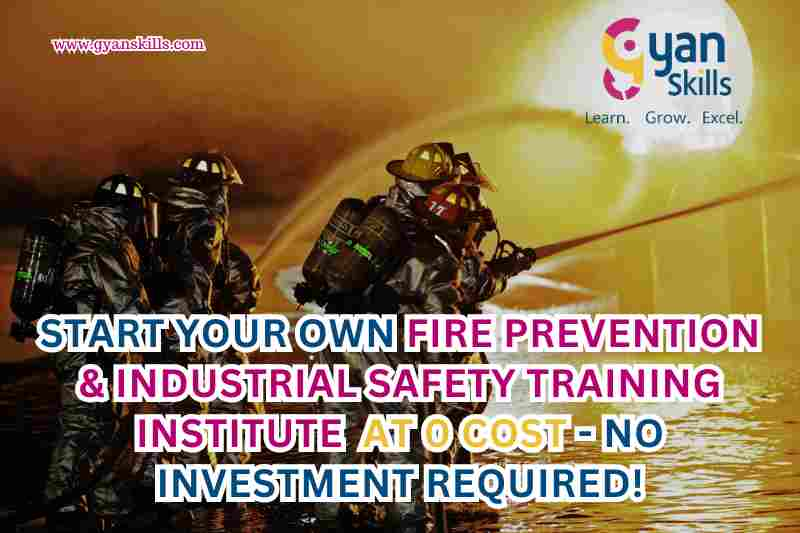
START YOUR OWN FIRE PREVENTION & INDUSTRIAL SAFETY TRAINING INSTITUTE AT 0 COST – NO INVESTMENT REQUIRED!
Updated for 2026
Start Your Own Fire Prevention & Industrial Safety Training Institute in 2026
Want to start a Fire Safety Training Institute, Industrial Safety Training Centre or Fire & Safety Training Institute? If you have experience in safety, fire prevention, emergency response or vocational education, a structured training-centre model can help you build a local skill-development business.
The safety-training sector is changing. Students are no longer looking only for a certificate. They want practical knowledge in fire prevention, industrial safety, emergency response, hazard identification, risk assessment, PPE, safety audits and workplace safety.
This updated 2026 guide explains how to start a Fire Prevention & Industrial Safety Training Institute, what courses students are looking for, what practical facilities you may need, how to structure training, what students should check before enrolling, and what you should verify before choosing a franchise.
2026 industry update:
Government training activity shows that occupational safety is becoming broader than
traditional fire-fighting alone. DGFASLI’s 2026 programme calendar includes training in
HIRA, process safety management, safety audits, emergency preparedness, PPE,
accident investigation, occupational hygiene, electrical hazards and AI/VR-related
machine safety. This is a useful signal for private institutes: students increasingly
benefit from a wider safety curriculum rather than a fire-only programme.
Want to Start a Fire & Industrial Safety Training Institute?
Get the latest information about the franchise model, course portfolio, certificate process and training-centre support.
What Is a Fire Prevention & Industrial Safety Training Institute?
A Fire Prevention & Industrial Safety Training Institute is a vocational training centre where students learn how to identify hazards, prevent incidents, respond to emergencies and promote safer working environments.
Depending on the programme, training can cover fire safety, industrial safety, occupational health and safety, emergency response, hazard identification and risk assessment, personal protective equipment, accident prevention, safety audits and disaster preparedness.
The strongest programmes combine classroom learning with practical demonstrations, case studies, drills and supervised exercises. Safety is not something students should learn only from a textbook.
Why Is Fire & Industrial Safety Training Important in 2026?
Industrial workplaces are becoming more complex. Manufacturing plants, construction sites, warehouses, logistics facilities, healthcare organisations, energy projects and other workplaces face different combinations of fire, machinery, electrical, chemical, height, confined-space and process-related hazards.
That is why safety training is also becoming broader.
DGFASLI’s 2026 training calendar includes dedicated programmes on process safety management, hazard identification and risk assessment, safety audits, emergency action plans, accident investigation, occupational hygiene, PPE, electrical hazards and behaviour-based safety. It also lists training on machine safety involving artificial intelligence and virtual reality.
For a private training institute, the message is straightforward: teach the fundamentals properly, but keep the curriculum connected to the hazards students may actually encounter in modern workplaces.
The 2026 opportunity:
Instead of marketing your institute as only a “fire course centre”, build a broader
Fire Safety + Industrial Safety + Emergency Response + HIRA + Workplace Safety
learning pathway.
What Are Students Really Asking About Fire & Safety Courses?
Recent online discussions among learners show that students have practical concerns before they spend money on a safety course. They want to know which qualification is useful, whether practical exposure is included, whether freshers can find internships and how much a certificate actually helps with employment.
For example, one recent Indian student discussion asked for guidance on choosing between a diploma, B.Voc and B.Sc. route and specifically highlighted the importance of hands-on training rather than theory alone.
Another 2026 discussion from a graduate with NEBOSH IGC focused on the difficulty of finding entry-level safety internships and gaining practical industry exposure.
Those concerns are valuable when designing a training centre because they reveal what students actually want to know.
- Which fire and safety course should I choose?
- Can I enter the safety field after Class 10 or Class 12?
- Is a diploma better than a short certificate course?
- Will I get practical fire-safety training?
- Do safety courses include HIRA and risk assessment?
- Can freshers get safety internships?
- Is a certificate enough to become a Safety Officer?
- What is the difference between Fire Safety and Industrial Safety?
- Should I study fire safety, industrial safety or EHS?
- Is NEBOSH necessary for a safety career?
- Can I work in construction, manufacturing or oil and gas?
- Can I start my own safety training centre?
Fire Safety vs Industrial Safety: What Is the Difference?
| Fire Safety | Industrial Safety |
|---|---|
| Focuses heavily on fire prevention, protection and emergency response. | Covers a wider range of workplace hazards. |
| Includes fire detection, evacuation and fire-fighting concepts. | Can include machinery, electrical, chemical, height, confined-space and process hazards. |
| Emergency preparedness is a major component. | Risk management and hazard control are major components. |
| Useful in buildings, factories, hospitals, warehouses and other facilities. | Relevant across construction, manufacturing, infrastructure, logistics and industrial workplaces. |
| Can form one part of a broader safety programme. | Often integrates fire, occupational health and multiple workplace safety disciplines. |
What Courses Can a Fire & Industrial Safety Training Institute Offer?
| Course / Module | What Students Can Learn |
|---|---|
| Fire Safety Training | Fire prevention, fire hazards, fire protection systems, emergency response and evacuation concepts. |
| Industrial Safety Management | Workplace hazards, safety procedures, inspections, documentation and safety-management principles. |
| Hazard Identification & Risk Assessment | Identifying hazards, evaluating risk and selecting appropriate control measures. |
| Emergency Response Training | Emergency planning, response procedures, evacuation and incident preparedness. |
| First Aid & Emergency Preparedness | Basic emergency-response awareness and first-aid concepts where appropriate. |
| PPE & Safe Work Practices | Selection, use and maintenance of personal protective equipment and safe working practices. |
| Safety Audit Fundamentals | Basic inspection, audit preparation, observations and corrective-action concepts. |
| Accident Investigation | Incident reporting, evidence collection, root-cause analysis and learning from incidents. |
| Occupational Health & Hygiene | Introduction to workplace health risks, exposure and preventive measures. |
| Disaster Management | Preparedness, response, recovery and emergency planning concepts. |
| Process Safety Fundamentals | Introduction to process hazards and safety-management concepts for relevant industries. |
Why HIRA Should Be Part of a Modern Safety Course
Hazard Identification and Risk Assessment (HIRA) is one of the most useful practical skills a safety learner can develop.
Instead of simply memorising safety rules, students learn to ask:
- What can go wrong?
- Who could be harmed?
- How serious could the consequence be?
- How likely is the event?
- What controls are already in place?
- What additional controls are required?
DGFASLI’s 2026 programme calendar includes dedicated training on HIRA, demonstrating that hazard identification and risk assessment remain an active occupational-safety training topic.
Should a Fire Safety Course Include Emergency Response?
Yes.
Knowing how to prevent an incident is important, but students also need to understand what happens when something goes wrong.
A well-structured programme can introduce:
- Emergency action plans
- Evacuation procedures
- Emergency communication
- Assembly-point management
- Basic incident reporting
- First-aid awareness
- Emergency drills
- Fire-response procedures
- Coordination and role allocation
DGFASLI’s 2026 training calendar includes dedicated programmes on emergency preparedness, emergency action plans and first aid in industrial settings.
Who Should Open a Fire Prevention & Industrial Safety Training Institute?
- Safety Professionals: People with experience in fire safety, industrial safety or EHS.
- Fire & Safety Trainers: Professionals who want to expand into structured vocational education.
- Engineers: Engineering professionals interested in technical skill development.
- Safety Officers: Professionals who want to share workplace safety knowledge.
- Entrepreneurs: People interested in entering the vocational education and training sector.
- Teachers: Educators interested in practical safety and risk-management training.
- Existing Training-Centre Owners: Institutes looking to add fire, safety and vocational programmes.
Do You Need a Fire & Safety Qualification to Open a Training Institute?
This question needs a careful answer.
The original franchise material states that a person with knowledge of fire safety, industrial safety and emergency protocols can start the institute.
However, owning a training centre and personally teaching every technical subject are not necessarily the same thing.
If your institute teaches advanced safety subjects, practical fire response or specialised industrial-risk topics, the trainers should have appropriate knowledge, experience and competence for the level being taught.
The official DGT Fire Technology & Industrial Safety Management CITS programme itself has defined entry requirements and is currently listed as a one-year, NSQF Level 4 programme. This is a good reminder that formal qualifications have specific eligibility and recognition requirements.
Important:
Do not advertise a private short-term certificate as an ITI, DGT, NSQF, NEBOSH or
government qualification unless that specific programme actually has the relevant
recognition or authorisation.
What Is the Difference Between a Short-Term Fire Safety Course and a Formal Qualification?
| Short-Term Private Training | Formal / Recognised Qualification |
|---|---|
| Usually focused on specific skills or topics. | Follows a defined qualification and assessment framework. |
| Duration depends on the provider. | Duration and eligibility are generally specified by the awarding framework. |
| Useful for supplementary or introductory learning. | May be required for specific career pathways or roles. |
| Recognition depends on the issuing organisation and programme. | Recognition is linked to the relevant official framework or awarding body. |
| Should not be marketed as equivalent to government qualifications without evidence. | Has defined recognition and qualification requirements. |
What Does the Current DGT Fire & Safety Training Landscape Look Like?
The Directorate General of Training currently lists Fire Technology & Industrial Safety Management under its Crafts Instructor Training Scheme.
The current listing shows:
- Duration: 1 year / two semesters
- NSQF Level: Level 4
- Revised curriculum year: 2024
- Batch size: 25
- Sector: Fire & Safety
The eligibility routes include qualifications such as B.Voc, BE/B.Tech in relevant fire/safety fields, certain advanced safety diplomas with experience, specific fire courses, defence experience and NEBOSH/OSHA certification with relevant experience.
This is useful context for students comparing private courses with formal training routes.
How to Start Your Own Fire Prevention & Industrial Safety Training Institute
| Step | What to Do |
|---|---|
| 1. Study Local Demand | Identify whether students, safety aspirants, working professionals and companies in your area need fire and industrial safety training. |
| 2. Choose Your Course Portfolio | Decide whether you will offer fire safety, industrial safety, HIRA, emergency response, PPE, accident investigation and other modules. |
| 3. Choose Your Training Model | Decide whether to operate independently or use a franchise/partner model. |
| 4. Verify the Franchise Terms | Confirm current fees, revenue sharing, course availability, certificate arrangements and partner responsibilities. |
| 5. Select a Suitable Location | Consider areas near colleges, industrial clusters, construction activity, training hubs and residential communities. |
| 6. Set Up Practical Facilities | Arrange suitable training equipment, PPE, demonstrations, emergency-response materials and safe learning facilities. |
| 7. Select Competent Trainers | Use trainers with suitable knowledge and practical experience for the subjects they teach. |
| 8. Build Practical Batches | Keep groups manageable so students receive demonstrations, practice and feedback. |
| 9. Assess Student Skills | Use written tests, practical assignments, drills, case studies and assessments where appropriate. |
| 10. Market Locally | Use local SEO, Google Business Profile, WhatsApp, social media, referrals and partnerships. |
Start Your Fire & Industrial Safety Training Institute
Ask the partner team about the current 2026 franchise model, available courses and centre requirements.
What Infrastructure Does a Fire & Safety Training Institute Need?
A safety institute should give students more than a classroom and PowerPoint slides. The exact facilities will depend on the curriculum, but a practical training environment can include:
- Classroom and presentation facilities
- Fire-safety demonstration equipment
- Appropriate fire extinguishers for supervised demonstrations
- Personal protective equipment
- Emergency-response training materials
- First-aid demonstration equipment
- Safety signage and evacuation diagrams
- Risk-assessment case-study materials
- Industrial safety posters and visual aids
- Basic inspection and safety-audit tools
- Suitable emergency-drill arrangements
- Good lighting, ventilation and safe access
Safety warning:
Fire and emergency-response demonstrations should only be conducted with appropriate
equipment, trained instructors, suitable supervision and applicable safety procedures.
Never encourage students to conduct uncontrolled fire experiments or hazardous drills.
Why Practical Training Matters in Fire & Industrial Safety
One of the strongest themes in recent learner discussions is the difference between having a certificate and having practical exposure.
A recent Reddit discussion from a graduate with NEBOSH IGC described difficulty finding entry-level safety opportunities and specifically highlighted the challenge of gaining practical industry exposure.
That is an important lesson for training institutes.
A student should ideally experience:
- Hazard-identification exercises
- Risk-assessment case studies
- Emergency-response simulations
- Safety inspections
- Incident-reporting exercises
- Safety-audit exercises
- PPE selection and demonstrations
- Fire-prevention demonstrations
- Emergency-action-plan exercises
- Workplace safety scenarios
Should Fire & Safety Courses Include HIRA, JSA and Risk Assessment?
Yes, where the course level and trainer expertise support it.
Students should learn how safety professionals move from identifying a hazard to evaluating risk and selecting controls.
Depending on the course, this can include:
- HIRA – Hazard Identification and Risk Assessment
- JSA – Job Safety Analysis
- Risk-control hierarchy
- Unsafe-act and unsafe-condition identification
- Corrective and preventive actions
- Safety inspection checklists
- Incident investigation basics
Should a Modern Safety Course Teach Accident Investigation?
It is a valuable addition.
Safety professionals need to understand not only how to prevent incidents but also how to learn from incidents that have already occurred.
A beginner-level module can introduce:
- Incident reporting
- Evidence collection
- Witness information
- Immediate and underlying causes
- Root-cause concepts
- Corrective actions
- Preventive actions
- Lessons learned
DGFASLI’s 2026 training calendar includes dedicated programmes on accident reporting, investigation and analysis, reinforcing the relevance of this skill.
Should Industrial Safety Students Learn About AI and VR?
Not every beginner needs to become an AI expert, but safety education is beginning to intersect with technology.
DGFASLI’s 2026 programme calendar includes a training programme on Machine Safety and the Use of Artificial Intelligence & Virtual Reality. That is a useful indication of where advanced safety training is heading.
For a private institute, this could eventually become an advanced workshop rather than a core beginner topic.
Can Students Build a Career After Fire & Safety Training?
Fire and industrial safety training can support different career pathways, depending on the student’s qualification, experience, practical competence and the requirements of the employer.
Potential job areas include:
- Fire Safety
- Industrial Safety
- HSE / EHS
- Construction Safety
- Manufacturing Safety
- Warehouse and Logistics Safety
- Infrastructure Projects
- Power and Energy Projects
- Healthcare Safety
- Emergency Response
- Safety Inspection and Compliance
Possible job titles vary by qualification and employer and can include Safety Supervisor, Safety Executive, HSE Trainee, Fire Safety Assistant, Safety Coordinator and other junior safety roles.
Does a Fire & Safety Certificate Guarantee a Job?
No.
This is one of the claims a responsible training institute should avoid.
A certificate can document that a student completed a programme, but employment also depends on practical skills, formal qualifications, experience, communication ability, employer requirements and the local job market.
Recent student discussions reinforce this point: even learners holding safety certifications can find entry-level opportunities difficult and may need practical experience or internships.
Is NEBOSH Necessary for a Fire & Safety Career?
Not necessarily for every role.
The right qualification depends on the job, employer, country and career stage. NEBOSH can be relevant for some safety careers, but it is not automatically the correct first step for every student.
The current DGT Fire Technology & Industrial Safety Management CITS entry requirements also recognise NEBOSH/OSHA certification with relevant experience as one of several possible routes into that particular instructor-training programme.
Students should therefore choose qualifications based on the career they want, rather than collecting certificates without a clear pathway.
Fire Safety Course vs Industrial Safety Course vs EHS
| Fire Safety | Industrial Safety | EHS |
|---|---|---|
| Strong focus on fire prevention and emergency response. | Broader workplace hazard management. | Combines environment, health and safety responsibilities. |
| Fire protection and evacuation. | Machinery, electrical, process, construction and other hazards. | Can include environmental compliance and occupational health. |
| Useful foundation for fire-response roles. | Useful for industrial and construction environments. | Often relevant to corporate and industrial management systems. |
What Support Can a Gyan Skills Franchise Provide?
The current Gyan Skills franchise information promotes a broader skill-development franchise model with 300+ courses, 24/7 call support, online and offline verification, marketing assistance and partner support.
Its current FAQ also states that franchise partners can receive support with course management, marketing, technical help and operational guidance, and that the model uses revenue sharing rather than upfront franchise fees.
The original Fire Prevention & Industrial Safety article specifically describes course content, training materials, expert assistance, online/offline class resources, brand support and promotion.
Because course portfolios and commercial terms can change, confirm the current fire-and-safety course availability and agreement before registering.
Does “Zero Cost” Mean the Training Institute Has No Expenses?
Important clarification:
“Zero franchise fee” and “zero operating cost” are not the same thing.
Gyan Skills currently promotes a zero-investment franchise model and states that there is no upfront franchise fee, while its FAQ explains that revenue sharing may apply.
A physical training institute can still have operating requirements such as:
- Premises or rent
- Furniture
- Fire-safety demonstration equipment
- PPE
- Training materials
- Electricity
- Internet
- Trainer costs
- Local marketing
- Maintenance
Always ask the provider to explain exactly which costs are covered by the franchise model and which costs remain the partner’s responsibility.
How to Market a Fire & Safety Training Institute in 2026
1. Target Local SEO Keywords
Create useful location-based pages around searches such as:
- Fire safety course in [city]
- Fire and safety institute in [city]
- Industrial safety course in [city]
- Fire safety training institute near me
- Industrial safety training centre near me
- HSE course in [city]
- Safety officer course in [city]
- Fire and industrial safety course in [city]
- HIRA training in [city]
- Occupational safety course in [city]
2. Create Helpful Student Content
Instead of publishing only promotional posts, answer the questions students search for:
- Which fire safety course is best after 12th?
- Fire safety diploma vs certificate course
- What does an industrial safety officer do?
- What is HIRA?
- What is JSA?
- Is NEBOSH worth it?
- Can freshers get safety jobs?
- What practical skills should a safety student learn?
3. Show Practical Training
Photographs and videos of demonstrations, drills, PPE practice, safety inspections and risk-assessment exercises can communicate the value of the institute better than generic claims about certificates.
4. Build Industry Connections
Where possible, develop relationships with manufacturing companies, construction organisations, warehouses, hospitals, contractors and other relevant workplaces.
Students often want exposure to real workplace conditions, so industry interaction can make the programme more useful.
5. Use WhatsApp and Local Search
Promote new batches, counselling sessions, workshops and practical demonstrations through WhatsApp, Google Business Profile and local social media.
Ready to Start Your Fire & Industrial Safety Institute?
Ask about the latest 2026 franchise terms, course availability, student certification and partner support.
Frequently Asked Questions About Fire & Industrial Safety Courses
1. What is a Fire Prevention & Industrial Safety Training Institute?
It is a vocational training institute that teaches students about fire prevention, workplace hazards, industrial safety, emergency response, risk assessment and related safety practices.
2. Is Fire & Industrial Safety a good career field in 2026?
It can be a useful career field for students interested in workplace safety, fire prevention, construction, manufacturing, infrastructure and EHS. Career outcomes depend on qualifications, experience, practical skills and the employer.
3. Can I join a fire and safety course after 12th?
Some private programmes accept 12th-pass students, but eligibility varies by programme. Formal qualifications such as DGT programmes have their own specific eligibility rules. Always check the exact course requirements before enrolling.
4. Can I join a fire and safety course after 10th?
Some vocational programmes may accept candidates after Class 10, while others require 12th, graduation, engineering or prior experience. Eligibility depends on the specific qualification.
5. What subjects are taught in a Fire Safety course?
Common subjects can include fire prevention, fire protection, emergency response, evacuation, fire equipment, safety procedures and incident preparedness.
6. What subjects are taught in Industrial Safety?
Industrial safety can include hazard identification, risk assessment, PPE, workplace inspection, accident prevention, safety audits, emergency planning and industrial safety management.
7. What is HIRA in industrial safety?
HIRA means Hazard Identification and Risk Assessment. It is a structured process used to identify hazards, evaluate risks and determine suitable controls.
8. What is JSA in safety?
JSA stands for Job Safety Analysis. It involves breaking a job into steps, identifying potential hazards and determining appropriate controls for each step.
9. Is practical training important in fire and safety courses?
Yes. Practical demonstrations, drills, risk-assessment exercises, inspections and case studies can help students connect classroom knowledge with workplace situations.
10. Can a fresher get a job in industrial safety?
Freshers can apply for entry-level opportunities, but finding the first role can be challenging. Practical experience, internships, relevant qualifications and strong communication skills can improve a candidate’s profile.
11. Is a certificate enough to become a Safety Officer?
Not necessarily. Job titles and eligibility requirements vary by employer and industry. Some positions require specific qualifications and experience in addition to safety training certificates.
12. Is NEBOSH compulsory for a safety career?
No. NEBOSH is one possible qualification, but it is not compulsory for every safety role. The right qualification depends on your target job, employer, country and career stage.
13. Is an industrial safety diploma better than a certificate course?
They serve different purposes. A diploma may provide broader and deeper study, while a certificate can focus on a specific skill or topic. Compare curriculum, recognition, duration, practical training and career requirements before choosing.
14. What is the current DGT Fire Technology & Industrial Safety Management course?
DGT currently lists Fire Technology & Industrial Safety Management under its Crafts Instructor Training Scheme as a one-year, two-semester, NSQF Level 4 programme.
15. What is the eligibility for the DGT Fire Technology & Industrial Safety Management CITS programme?
DGT lists several eligibility routes, including relevant B.Voc/BE/B.Tech qualifications, certain advanced safety diplomas with experience, specific fire courses, defence experience and NEBOSH/OSHA certification with relevant experience.
16. Is a private fire safety certificate the same as a DGT qualification?
No. A private certificate and a DGT qualification are different credentials unless the specific programme has the relevant official recognition.
17. Can I learn fire safety online?
Online learning can be useful for theory, regulations and concepts, but practical fire-response and emergency training may require appropriate supervised demonstrations and exercises.
18. Can I get practical fire-fighting training?
A training institute can include practical demonstrations and drills, but the exact practical facilities depend on the institute and course. Students should ask specifically how much practical training is included before enrolling.
19. What is emergency response training?
Emergency response training teaches people how to prepare for and respond to incidents through emergency plans, communication, evacuation, drills, role allocation and other appropriate procedures.
20. Should industrial safety courses teach accident investigation?
Yes, it is a valuable skill. Students can learn incident reporting, evidence collection, cause analysis, corrective actions and lessons learned.
21. What is process safety management?
Process safety management focuses on preventing major incidents associated with hazardous industrial processes by identifying and controlling process-related risks.
22. Should a safety course include PPE training?
Yes. Students should understand how to select, use, inspect and maintain appropriate personal protective equipment for different workplace hazards.
23. What industries hire safety professionals?
Safety professionals may work across construction, manufacturing, infrastructure, logistics, healthcare, energy, oil and gas, warehouses and other industrial environments. Specific job eligibility varies.
24. What jobs can I get after a fire and safety course?
Depending on your qualification and experience, possible roles include Safety Supervisor, Safety Executive, HSE Trainee, Safety Coordinator, Fire Safety Assistant and other entry-level or support roles.
25. Can I work in construction safety after a fire and safety course?
Potentially, depending on the qualification and employer requirements. Construction safety may require additional knowledge of work-at-height, excavation, lifting, electrical hazards, PPE and site safety procedures.
26. Can I work in oil and gas after a short safety course?
Oil and gas roles can have specialised qualification and experience requirements. A short course alone should not be assumed to qualify a candidate for every oil and gas safety position.
27. Can I start a fire safety training institute without being an engineer?
The original franchise material states that a person with relevant fire-safety, industrial-safety and emergency-protocol knowledge can start the institute. However, technical subjects should be taught by suitably competent trainers.
28. Who can start a Fire & Industrial Safety Training Institute?
Safety professionals, engineers, safety officers, teachers, trainers, entrepreneurs and existing training-centre owners can explore the opportunity.
29. Can I run a Fire & Safety Training Institute part-time?
The original franchise material states that the institute can be operated part-time or full-time, subject to the centre’s schedule and applicable requirements.
30. How long are the Fire & Industrial Safety courses?
The original franchise article states that its courses generally range from 1 to 3 months depending on complexity and depth. Other formal fire and safety qualifications can be substantially longer.
31. Will students receive a certificate?
The original franchise material states that students receive a certificate after course completion and describes QR-code verification.
32. Can certificates be verified online?
The original programme states that online and offline certificate verification options are available.
33. Is a QR-code certificate the same as government recognition?
No. A QR code is a method of verifying certificate information. It does not by itself prove that a course has government, DGT, NSQF, NEBOSH or other statutory recognition.
34. Can I start my own safety consultancy after a course?
That depends on your qualifications, experience, services offered and applicable legal or contractual requirements. A short training course should not automatically be presented as sufficient for every professional consultancy service.
35. Is fire safety a good option for women?
Yes. Safety careers are open to women and men. The suitability of a specific role depends on qualifications, workplace conditions, job requirements and individual career goals.
36. Can working professionals study fire and industrial safety?
Some institutes offer flexible schedules, online components or part-time programmes. Always check whether the specific qualification is accepted by the employer or industry you are targeting.
37. What should I check before joining a Fire & Safety Institute?
Check the trainer’s experience, course curriculum, practical facilities, certificate issuer, recognition claims, duration, total fees, internship or placement support and whether the institute provides real practical exposure.
38. What should I check before buying a safety-training franchise?
Ask for the current franchise agreement, fees, revenue-sharing terms, course list, certificate process, marketing support, trainer requirements, centre requirements, renewal terms and student-registration process.
39. Does Gyan Skills offer a zero-investment franchise?
Gyan Skills currently promotes a zero-investment franchise model and states that there is no upfront franchise fee. Its FAQ also states that revenue sharing may apply.
40. Does Gyan Skills offer online certificate verification?
Yes. Current Gyan Skills franchise information promotes online and offline verification of applicable student, centre and certificate information.
41. Does Gyan Skills provide marketing support?
Current franchise information promotes marketing guidance, branding and promotional support for partners.
42. How do I apply for a Fire Prevention & Industrial Safety Training Institute franchise?
You can submit an enquiry through the official Gyan Skills partner page and discuss the current course availability, franchise process, centre requirements and terms.
Ready to Start Your Fire & Industrial Safety Training Institute?
Build your institute around practical safety skills, credible information and career-focused training. Speak with the partner team before making a commitment.
Final Thoughts: Is a Fire & Industrial Safety Training Institute a Good Business Idea in 2026?
Fire safety and industrial safety are becoming broader professional fields. The conversation is moving beyond extinguishers and emergency drills towards risk assessment, process safety, occupational health, safety audits, accident investigation, emergency planning, PPE and technology-enabled safety.
Government training activity in 2026 reflects that wider direction, while student discussions show that learners are looking for practical exposure and realistic career guidance rather than certificates alone.
That creates an opportunity for a training institute that teaches the fundamentals well, provides meaningful practical learning and clearly explains what its certificates do and do not represent.
If you are a safety professional, engineer, trainer, teacher or entrepreneur, a Fire Prevention & Industrial Safety Training Institute can be worth exploring as a skill-development business.
But the most important rule is simple: keep the claims realistic. Do not promise guaranteed jobs, government recognition or professional eligibility unless you can substantiate those claims.
Have Questions Before Applying?
Speak directly with the partner team about the current franchise, course portfolio and centre requirements.
Useful Official Resources
Disclaimer: Course eligibility, certification, government regulations, franchise terms and training requirements can change. Verify the latest information with the relevant government authority, awarding body and training provider before enrolling students or making a business decision.
A private training certificate should not be represented as an ITI, DGT, NSQF, NEBOSH, government or statutory qualification unless the specific programme has the relevant recognition.
Completion of a fire or industrial safety course does not guarantee employment, salary, licensing or business success.